On August 12, 2026, the Moon's shadow will cross the Iberian Peninsula — the first total solar eclipse visible from Spain in 121 years.
The reason total solar eclipses are possible at all is an extraordinary coincidence.
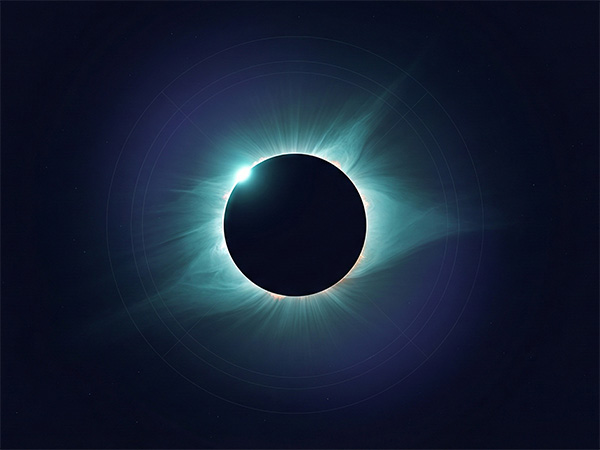
The Sun is about 400 times larger than the Moon — and also about 400 times farther away. From Earth, they appear almost exactly the same size in the sky. This balance allows the Moon to cover the Sun precisely, revealing the solar corona — a glowing halo normally hidden by the Sun's intense brightness.
This alignment is temporary on a cosmic timescale. The Moon is slowly drifting away from Earth, and in roughly 600 million years, total solar eclipses like this will no longer occur.
We are living in a narrow window of time where this is even possible.
The low sun creates an unusual viewing experience. The eclipse will unfold close to sunset, casting long shadows across the landscape as darkness falls. Venus will shine brightly to the southwest. The horizon itself becomes part of the spectacle.
When the Sun is fully obscured:
The solar corona becomes visible — the Sun's outer atmosphere, extending millions of kilometers into space. Bright planets appear in the darkened sky. The air temperature drops by several degrees within minutes.
The quality of light changes — metallic, surreal, almost unreal. Shadows sharpen, colors shift, and the landscape feels briefly transformed.
Animals often react. Birds may fall silent. Insects may begin their nighttime sounds. The atmosphere itself responds.
This is not something you simply watch. It's something you feel.
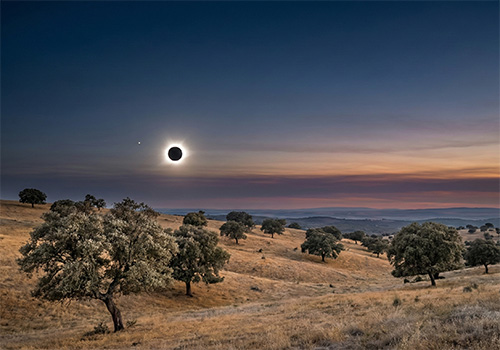
At any given moment, totality is visible from less than half a percent of Earth's surface.
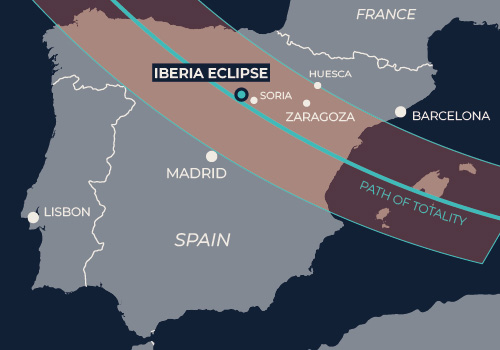
The Moon's shadow — called the umbra — races across the planet at speeds of up to 1,700 km/h, touching down in a narrow path before lifting again. Most locations on Earth experience a total solar eclipse only once every 300 to 400 years.
For this eclipse, northern Spain lies directly in the path of totality — one of the best viewing regions for any total solar eclipse 2026 festival. People travel across continents to stand where we will already be.
During the eclipse, all stages and amplified music will pause. Not in silence — but in space. A shared pause, allowing everyone to gather, look up, and witness the moment together.— A Shared Moment at Iberia Eclipse
Humans have recorded eclipses for over 4,000 years. Across cultures, they have marked moments of transition, reset, and reflection.
Even today — with all our technology — first-time observers consistently describe totality as overwhelming, emotional, and impossible to fully capture in photos or video.
You don't just remember seeing an eclipse. You remember where you were, who you were with, and how it felt.
Join the best total solar eclipse 2026 festival on the centerline — 1 minute and 42 seconds that will stay with you forever.
Secure Your Ticket