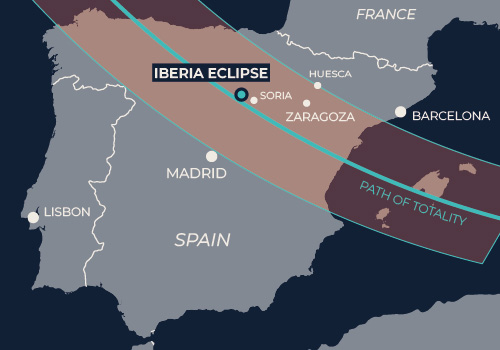
Of all the places the Moon's shadow will touch — from Arctic Russia to the Balearic Sea — Vinuesa offers one of the longest, clearest, and most spectacular viewing experiences on Earth.
The Moon's shadow will sweep across Earth in a narrow path roughly 200 kilometers wide. Within this path, the closer you are to the centerline, the longer totality lasts.
Vinuesa sits almost exactly on the centerline — maximizing your time in complete darkness. At 1 minute and 42 seconds, this is one of the longest durations available anywhere in Spain.
Every second matters. The difference between centerline and edge can mean 30 seconds less of totality.
Totality will occur at 20:29 local time, with the Sun just 8-10 degrees above the western horizon.
This creates an extraordinary viewing experience. The sky will display deep sunset colors across the entire horizon — gold, orange, and pink — while the corona glows overhead.
Long shadows will stretch across the landscape. The quality of light will be unlike any midday eclipse. It's as if the Sun is setting during totality.
The horizon becomes part of the show.
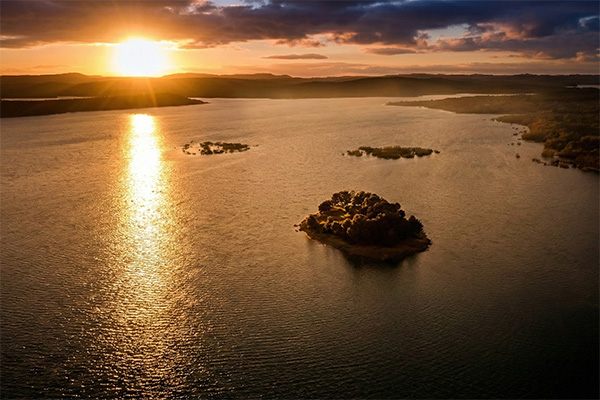
Vinuesa sits in the province of Soria — one of the least populated regions of Spain. The landscape here has remained largely unchanged for centuries.
Pine forests extend across rolling hills. The Cuerda del Pozo reservoir catches the light. To the north rises the Sierra de Urbión, home to the glacial Laguna Negra. To the south, the high plains of Castile stretch toward the horizon.
This is not an industrial zone or a crowded tourist coast. It's a landscape of space, silence, and sky — exactly what an eclipse deserves.
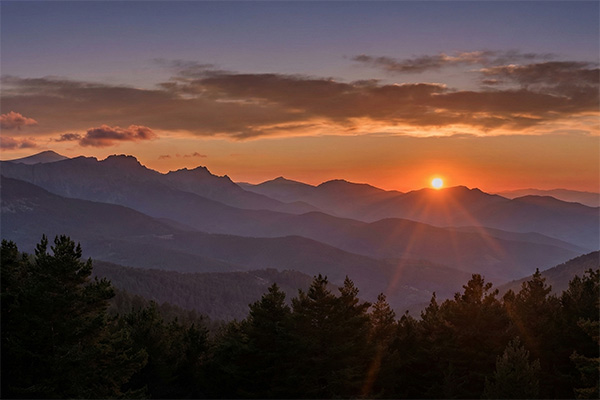
A landscape of space, silence, and sky — exactly what an eclipse deserves.
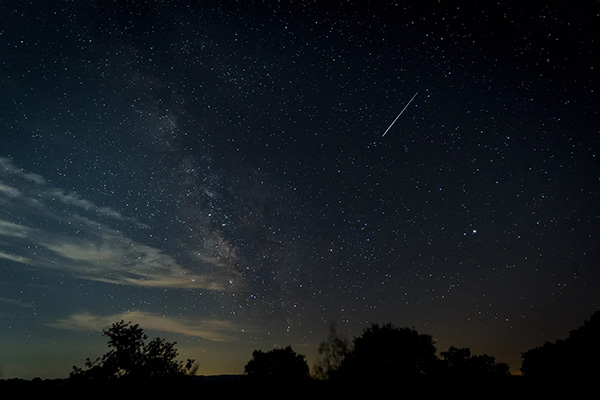
Soria province has some of the darkest skies in Europe. With fewer than 9 inhabitants per square kilometer, artificial light is scarce.
During totality, when the Sun disappears, this darkness matters. Stars and planets will emerge more clearly here than in any coastal city. The solar corona — the Sun's outer atmosphere — will glow against a truly dark sky.
The Starlight Foundation has recognized this region for its exceptional astronomical conditions. You couldn't design a better natural observatory.
Total solar eclipses are visible from any given location only once every 300-400 years on average.
The last time a total eclipse crossed this part of Spain was August 30, 1905 — 121 years ago.
The next one after 2026? Not until 2027 — but that path will miss Soria entirely.
This is not just a good place to see the eclipse. For this eclipse, it may be the best place in Europe.
Four stages. Music, art, workshops, and wellness — shaped by the landscape and anchored by the eclipse.
The Experience